Businesses are emerging online at a rapid pace. The digital era demands that every business show up its presence to stay competitive and on top of customers’ minds. However, it’s not a matter of days that can be easily fixed. Rather, it requires an endless, ongoing effort in the form of SEO.
In our previous posts, we have already covered SEO, digital marketing, content marketing, and WordPress website development.
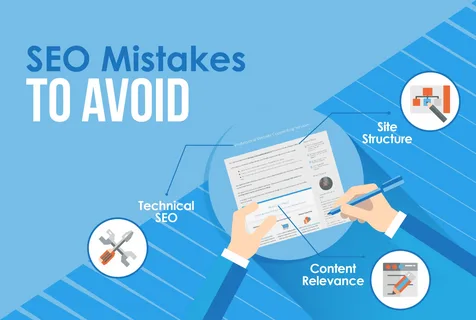
Today, we are going to cover something that is often ignored by businesses and prevents them from leading the rankings. That’s right, the biggest SEO mistakes that prevent businesses from making a place in the top of Google.
What are those SEO mistakes and how to avoid them? Here is a detailed guide on it.
Common On-Page and Technical SEO Mistakes that Kill Your Rankings
Here are some of the top on-page and technical SEO mistakes that kill your rankings.
Blocking Crawlers
Search engines use bots to scan websites. They follow links, read content, and store information in the search engine’s index. Indexed pages are then eligible to show up in search results.
Blocking crawlers means preventing search engine bots (like Googlebot, Bingbot, etc.) from accessing and indexing your website. If crawlers can’t reach your pages, they won’t appear in search results, which is why this mistake can cost businesses.
What Blocking Crawlers Looks Like?
- The robots.txt file tells crawlers which pages they can or cannot access.
- Using <meta name=”robots” content=”noindex”> or nofollow incorrectly can stop indexing.
- Some sites unintentionally block bots at the server level (e.g., via IP restrictions).
Weak or Missing Title Tags
Weak or missing title tags and meta descriptions are classic on-page SEO mistakes that directly affect both rankings and click-through rates. Let’s break it down:
Title Tags are clickable headlines that appear in search results. Search engines use them to understand page content, and users rely on them to decide whether to click or not. Poor titles confuse search engines, lower relevance, and reduce clicks.
Some of the common mistakes often ignored by businesses include:
- Missing title tags (no defined <title>).
- Titles too long (over ~60 characters) or too short.
- Keyword stuffing (unnatural repetition).
- Duplicate titles across multiple pages.
Meta Descriptions are short excerpts (up to ~160 characters) shown under the title in search results. They don’t directly affect rankings, but they strongly influence click-through rate (CTR).
Weak descriptions mean fewer clicks, which indirectly signals to Google that your page isn’t valuable. Some of the common mistakes include:
- Missing descriptions (Google auto-generates one, often poorly).
- Duplicated across multiple pages.
- Too long or too short.
- Not compelling enough to entice users to click
Keyword Stuffing worked well back in 2011 and 2012. However, with Google’s Algorithm rollout, keyword stuffing can do more harm than good. Keyword stuffing simply means that your website is going to be penalized sooner or later.
Some of the common mistakes include:
- Excessive repetition of keywords is perceived as ranking better
- Using irrelevant keywords to attract traffic in spammy ways
- Using hidden keywords through white text so that users can’t see them.
Thin or Duplicate Content
Another big mistake is publishing thin content or duplicate content. A lot of Google rollouts in the past were about content and its quality. If you are not focusing on quality content, sooner or later, your website will see the impact.
Some of the common mistakes include:
- Publishing thin content in quantity instead of quality content
- Copying and pasting content from websites that are already ranking
- Publishing irrelevant blogs and pages that are not relevant to the niche or business
- Creating content without proper keyword research and competitor analysis
Poor Internal Linking
Poor internal linking refers to another on-site SEO practice with a weak correlation between pages on the website. Internal links play an important role in helping search engines to navigate your website, pass authority juice, and understand the connection with the content. When done wrongly, it might lead to serious consequences.
Common mistakes include:
- Pages exist in isolation, with no links pointing to them.
- Using “click here” or “read more” instead of descriptive keywords.
- Links pointing to 404 pages or removed content
- Adding too many links in one section makes it look unnatural
- Only a few pages get a lot of internal links, while others don’t get a single one
Slow Page Speed
Slow page speed is the biggest culprit for deranking your website from top to bottom. It is one of the biggest SEO factors that leads to losing rankings. Search engines prioritize only websites that load quickly and do not affect the user experience and engagement.
Some of the common mistakes include:
- High-resolution images without compression can add several MBs to a page
- Bloated CSS, JavaScript, or HTML slows rendering
- Cheap or overloaded servers can’t deliver content quickly.
- Without browser or server caching, pages reload resources every time
- Sites not tailored for mobile devices often load slowly on smartphones.
Mobile Optimization/Responsive Website
When it comes to traffic, a majority of the traffic is driven through mobile devices, including smartphones and tablets. However, failing to design and optimize a website for these devices will ultimately send negative signals to the search engines, resulting in deranking. Moreover, it is also important to build a responsive website to capture a major portion of traffic.
Some of the common mistakes include:
- Pages don’t adjust to different screen sizes.
- Heavy images, unoptimized scripts, or poor hosting make mobile load times painfully slow
- Buttons and links too small to tap easily
- Intrusive ads or banners covering the screen on mobile devices
- Fonts are too small or have poor contrast, making content hard to read on smaller screens
Broken Links & 404 Errors
Broken links and 404 errors are common on-page SEO issues that not only hurt rankings but also offer a poor user experience. Some of the common mistakes include:
- Many site owners forget to check for broken internal or external links
- Linking to third-party sites that later change or remove their content results in broken outbound links.
- Pages with query strings or tracking parameters often generate duplicate or broken versions
- Tools like Google Search Console flag broken links and 404s
Poor Content Structure
Poor content structure means that the content on the page is not aligned properly. For instance, if the content is not distributed equally and not separated with h2, h3, and h4, the search engines find it difficult to interpret. Moreover, it can also ruin user experience.
Some of the common mistakes include:
- Text without headings makes it hard for readers and crawlers to understand the hierarchy of information
- Having more than one H1 confuses search engines
- Long blocks of text without breaks reduce readability
- Not using bullet points, numbered lists, or bold text for key ideas makes scanning difficult
- Stuffing keywords into headings instead of writing naturally
- Relying only on text without images, charts, or visuals makes content less engaging
Not Using Schema Markup
Schema markup is just like structured data that allows search engines to recognize your content more clearly and display the results accordingly.
Some of the common mistakes include:
- Search engines only see plain text, missing opportunities for getting a place in rich snippets or an AI overview
- Using the wrong or inappropriate schema, or leaving the required fields
- Duplicate or contradicting schemas will also lead to a bad impact on SEO
- Failing to test the schema before making it live
- Only using basic schema markup and ignoring the important ones, such as product, event, how-to, and FAQs.
Summing Up
If you want to grow your business digitally, taking care of each aspect related to SEO will surely bring a boost to your rankings. A lot of businesses complicate the SEO and its processes, which ruins the overall credibility and exposure of the website.
However, taking care of all these SEO mistakes we have discussed will give you the edge over your rivals.
And if you are really looking for someone to help you out in the process without wasting too much time, Phoenix Coderexhas got you covered. Get in touch with us now and let us know about your requirements.

We drive targeted traffic and conversions using data-driven digital marketing strategies.
We design scalable, user-focused websites aligned with your business goals and growth.
We build fast, secure, and fully customized web solutions tailored to your needs.
Develop fast, secure, and fully customizable WordPress websites that align with your brand and deliver a seamless experience across all devices.