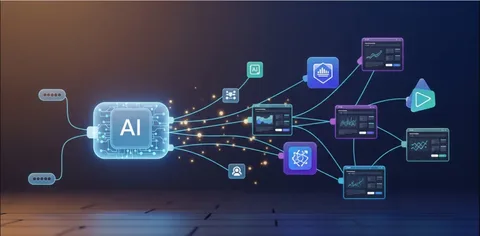
Artificial Intelligence is the talk of the town, and everyone is keenly interested in knowing its benefits, consequences, and impact. The transformation is shaping many industries and sectors, including education, health, finance, retail, and business.
AI automation is helping small and big enterprises to boost efficiency, reduce costs, and open new doors to opportunities.
AI Automation combines both Natural Language Processing and Machine Learning to handle complex tasks that require human intervention and plenty of time to complete. Businesses can now focus more on innovation and strategy, instead of wasting time on mundane tasks.
What is AI Automation?
AI Automation is the use of artificial intelligence to process complex business tasks without the involvement of humans. The AI-powered system can make decisions on its own and adapt to changes, unlike traditional system automation that strictly follows if-then rules.
What is Traditional Automation?
Traditional automation is a rule-based system that executes repetitive tasks with a fixed set of instructions. Unlike AI automation, it does not adapt to new situations or learn new things. It is predictable and works best in structured environments where inputs and processes rarely change.
Difference between Traditional Automation and AI-driven Automation
Traditional automation and AI-driven automation core purpose is to reduce manual work, save time, and effort. However, the mode and functionality of both AI-automation and traditional automation are different due to intelligence, efficiency, and adaptability. Here are some of the main differences.
Aspect | AI Automation | Traditional Automation |
Core Technology | Uses machine learning, natural language processing, and adaptive algorithms | Relies on fixed rules, scripts, and pre‑programmed logic |
Flexibility | Highly adaptable; learns and improves over time | Rigid; requires manual updates to change processes |
Decision-Making | Can analyze data and make context‑aware decisions | Executes predefined instructions without intelligence |
Scalability | Scales dynamically with data and complexity | Limited scalability; expansion requires significant reprogramming |
Use Cases | Customer support chatbots, predictive analytics, and fraud detection | Assembly line robots, batch processing, simple workflow automation |
Cost Efficiency | Long‑term savings through reduced human intervention and smarter resource use | Short‑term savings but higher maintenance and update costs |
Customer Experience | Enables personalization and proactive service | Provides standardized, one‑size‑fits‑all service |
AI Automation Statistics
- Nearly two-thirds of organizations remain in the experimentation or pilot stage, with few scaling AI enterprise-wide.
- 62% of respondents report their organizations are at least testing AI agents.
- Use-case benefits in cost savings and revenue are evident, and 64% say AI is fueling innovation. Yet only 39% see enterprise-level EBIT gains.
- While 80% set efficiency as an AI objective, the most successful companies also prioritize growth and innovation.
- Half of AI leaders plan to transform their businesses with AI, often by rethinking workflows.
- 32% foresee workforce reductions, 43% anticipate no change, and 13% expect increases.
Key Benefits of AI Automation in Business
Businesses are adopting AI automation at large for many reasons. Let’s take a look at some of the key benefits of AI automation in business.
Enhanced Efficiency
One of the reasons businesses are adopting AI automation is due to its ability to learn, improve, and deliver work. For instance, AI-powered email processing can improve accuracy up to 95%.
AI automation makes it easy for organizations to process unstructured data, manage data entry, and fill out forms. Compared to humans, the same process requires a lot of time and effort that can be utilized in some other productive work. Moreover, the chances of errors are higher when it comes to humans.
Cost Reduction
Automation is the new way to save money on business operations. When it comes to clerical or labor work, the cost is quite high as humans are not available cheaply. However, when it comes to AI automation in business, the operational costs can be reduced significantly.
Moreover, AI automation is free of errors, which means the AI system follows predefined functions consistently and avoids costly mistakes like manual errors and fixes.
Data-Driven Decisions
AI automation for business can be beneficial in terms of making decisions. For instance, AI is able to collect data, analyze it, and forecast the consequences. Businesses can adopt those measures to increase revenue, scale up their operations, and stay in the competition.
In addition, AI can also predict demand, manage inventory levels, and identify equipment failures beforehand. This allows businesses to prevent hefty losses and take measures before things go out fo control.
Scalability
AI-powered automation is scalable, which means no matter how much the workload increases, it can handle it without hassle. The adaptability is viable for rapidly growing businesses, as AI systems are able to meet increased workload without any alteration in the system. AI evolves and offers flexibility as businesses scale up and evolve.
Enhanced accuracy
AI systems excel at processing massive datasets with remarkable precision, uncovering insights and patterns that often escape human analysis. By leveraging machine learning, businesses can achieve far greater accuracy in forecasting areas such as sales demand, inventory control, and financial planning.
In customer service, AI-powered chatbots deliver consistent, reliable responses trained on extensive data, reducing variability across interactions. With natural language processing (NLP), these systems interpret queries more accurately, minimizing misunderstandings and ensuring customers receive clear, effective support.
Core Areas Where AI Automation is Transforming Business
AI is revolutionizing businesses and has improved operations and efficiency compared to the past. From reducing repetitive workflows to intelligent and data-driven decisions, businesses are leveraging AI in several key areas. Here are some of the areas where AI is taking part in improving overall business performance, efficiency, and productivity.
Customer Service & Experience
AI is enhancing customer service and experience by offering better and faster interactions that is smart and personalized. For instance, a virtual assistant and chatbots can handle multiple queries simultaneously, without any errors or discrepancies.
Moreover, AI also helps in reducing the wait time that customers often face through traditional customer support offered by humans.
Unlike traditional scripted systems, these AI-driven tools use NLP to understand customers’ intent. The consistency and precision not only improve customer satisfaction but also build trust and loyalty.
Marketing & Sales
Artificial Intelligence is transforming marketing and sales into highly efficient, data-driven operations that maximize revenue and improve the customer experience. Some of the ways AI helps in marketing and sales include:
Marketing Optimization: AI analyzes customer behavior to deliver highly personalized campaigns, utilizes machine learning to maximize ad spend, and implements pricing based on real-time market demand.
Sales Efficiency: AI streamlines the sales funnel by prioritizing high-conversion leads, predicting trends through analytics, and using chatbots to guide customers towards purchase.
The AI technology hence reduces wasted resources, boosts overall revenue, and ensures the delivery of personalized customer interactions.
Operations & Supply Chain
Artificial Intelligence is making supply chains smarter and more efficient by replacing traditional methods with automated and data-driven solutions. Some of the key takeaways include:
Predictive Efficiency: AI utilizes predictive analytics to forecast demand without any discrepancy. It also leverages Machine Learning to forecast maintenance before it causes costly downtime.
Logistics & Visibility: Artificial Intelligence optimizes delivery routes to reduce costs, track inventory, and manage supplier information.
Increased Strength: Automating monotonous tasks and offering real-time analytics, AI helps in reducing waste and allows businesses to fit perfectly in global disruptions and demand shifts to ensure efficient product delivery.
Human Resources & Recruitment
Artificial Intelligence is transforming human resources in a number of ways by automating mundane tasks, free and fair hiring, and enhancing employees’ satisfaction and experience. Some of the key takeaway inlcude:
Smarter Recruitment: AI tools help boost the hiring process and reduce the bias that comes when humans are involved. From screening thousands of applications to filtering out the best ones that fit the role, AI offers smart recruitment for corporates and agencies.
Retaining Employees: By analyzing surveys and communication patterns, AI scans workforce culture, predicts overall turnover risk, and pinpoints specific employee training needs.
Strategic Shift: Automating repetitive tasks such as payroll, benefits, and compliance checks allows human resource personnel to focus more on productive tasks and organizational culture.
Finance & Accounting
Artificial intelligence is revolutionizing finance and accounting by replacing mundane tasks with precision. The automated system mitigates risk and drives long-term profitability. Some of the key takeaways include:
Automated Accuracy: AI accelerates routine processes like involving, expense management, and financial reporting. The intelligent systems eliminate reconciliation errors and flag audit inconsistencies automatically.
Advanced Risk & Fraud Detection: Machine learning models analyze transaction patterns in real time to detect abnormalities, leading to superior fraud prevention and reduced compliance risks.
Strategic & Predictive Insights: By processing massive financial datasets, AI delivers highly reliable forecasting, discovers cost-saving opportunities, and assesses risk exposure.
Industry Specific AI Application
Here are some of the industry-specific AI applications:
Healthcare
Artificial Intelligence is modernizing healthcare by shifting medicine to a proactive, data-driven system. It optimizes clinical accuracy, eliminates administrative bottlenecks, and accelerates medical research. Some of the key takeaways include:
Early Diagnostics: AI imaging systems analyze medical scans with high precision, flagging early-stage conditions like cancer or heart disease to improve patient survival rates.
Efficient Patient Management: Automated workflows handle routine administrative responsibilities, such as scheduling appointments and updating electronic health records. Whereas 24/7 virtual assistants guide patients through their care plans.
Accelerated Drug Discovery: Machine learning models simulate and predict how chemical compounds will behave in the human body, drastically compressing the time and multi-billion-dollar costs traditionally required to bring new medications to market.
Retail and E-commerce
Artificial Intelligence is modernizing the retail landscape by creating highly customized consumer journeys while automating complex operations. The approach maximizes profitability and eliminates traditional supply chain friction. Some of the key takeaways include:
Hyper-Personalization: AI tracks real-time engagement, purchase history, and browsing habits to deliver tailored product recommendations, turning data into higher sales conversions.
Smart Inventory Management: AI forecasts consumer demand with high precision, allowing retailers to optimize stock levels, prevent costly stockouts, and eliminate bloated overhead from overstocking.
24/7 Automated Support: AI Chatbots can handle routine tasks such as customer inquiries and process order tracking without any delays. They also gather data and make personalized recommendations based on past behavior, resulting in a seamless shopping experience.
Manufacturing
Artificial Intelligence is modernizing the manufacturing sector by transitioning factories from reactive troubleshooting to proactive, automated operations. This shift drastically minimizes unexpected equipment failures and drastically lowers product error rates.
Predictive Maintenance: Machine learning models analyze live machine performance data to forecast and address equipment degradation before it causes catastrophic breakdowns. It extends lifespan and prevents costly production halts.
Quality Control: By instantly catching microscopic flaws and structural abnormalities invisible to human operators, AI optimizes consistency while significantly lowering material waste and rework.
Artificial Intelligence in Finance
Artificial Intelligence is modernizing the financial sector by upgrading legacy, rule-based systems with real-time automation and predictive intelligence. The shift dramatically improves security, streamlines strict regulatory compliance, and refines asset risk assessment. Some of the key takeaway inlcude:
Real-Time Fraud Prevention: AI algorithms analyze massive transaction streams instantly to flag subtle, anomalous behavior. This proactive threat hunting stops fraudulent activity mid-transaction, mitigating steep financial losses and protecting customer assets.
Automated Compliance Reporting: AI modernizes regulatory workflows by compiling financial data and generating compliance filings automatically. This eliminates manual reporting errors, reduces human oversight hours, and guarantees institutional compliance with shifting financial regulations.
Predictive Risk Assessment: Machine learning models process unconventional data points alongside traditional metrics to evaluate a borrower’s true creditworthiness. This granular analysis yields deeper behavioral insights, optimizes loan approval speed, and minimizes credit default rates.
Education
Artificial Intelligence is modernizing the educational landscape by shifting from a rigid, “one-size-fits-all” framework to an inclusive, highly adaptable learning environment. It relieves educators of heavy administrative tasks while giving students customized, round-the-clock academic support.
Hyper-Personalized Learning: Adaptive AI platforms analyze a student’s real-time performance, strengths, and weaknesses to customize lesson plans dynamically. This ensures students master concepts at their own pace without falling behind or getting bored.
Automated Assessment: Intelligent systems handle routine grading and feedback with high consistency. This eliminates manual bottlenecks, ensuring impartial evaluations and freeing up teachers to focus on mentorship and interactive instruction.
24/7 Virtual Tutoring: AI-powered digital tutors provide students with on-demand, round-the-clock guidance. They break down complex topics, answer immediate questions, and offer tailored practice exercises outside of traditional classroom hours.
Summing Up
Artificial Intelligence has transitioned from a futuristic concept into an essential, present-day force driving cross-industry modernization. It systematically replaces reactive business models with proactive, insight-driven operations capable of adapting to shifting market demands.
Across healthcare, retail, manufacturing, finance, and education, AI universally elevates operational efficiency, diagnostic/analytical accuracy, and user personalization to unprecedented levels.
By combining automation with predictive analytics, organizations shift away from costly reactive troubleshooting, significantly lowering overhead costs while unlocking entirely new pathways for innovation.
Transform Your Business with Phoenix Coderex AI Automation
The future of business isn’t about working harder; it’s about working smarter. Phoenix Coderex LLC helps organizations transition into enterprise-wide AI adoption. With our automation solutions, you can:
- Boost efficiency by streamlining repetitive tasks and reducing operational costs.
- Drive innovation by redesigning workflows and unlocking new opportunities for growth.
- Scale with confidence by implementing AI agents that adapt to your unique business needs.
- Gain measurable impact with cost savings, revenue growth, and accelerated decision-making.
High-performing companies are already proving that AI isn’t just about efficiency; it’s about transformation. By partnering with Phoenix Coderex, you’ll be the pioneer in your industry that uses AI to fuel innovation, redesign processes, and stay ahead of the competition.
Whether you’re looking to optimize your workforce, enhance customer experiences, or unlock new revenue streams, Phoenix Coderex provides the expertise and technology to make it happen.
Don’t wait for the future; create it now.
Contact Phoenix Coderex LLC today to scale AI automation across your enterprise and turn curiosity into a competitive advantage.

We drive targeted traffic and conversions using data-driven digital marketing strategies.
We design scalable, user-focused websites aligned with your business goals and growth.
We build fast, secure, and fully customized web solutions tailored to your needs.
Develop fast, secure, and fully customizable WordPress websites that align with your brand and deliver a seamless experience across all devices.