
Businesses are thriving more on the latest technological advancement and less on human involvement. Although there are a few loopholes that can’t be done without humans, yet they are heavily relied upon.
In recent times, the talk of the town has been Artificial Intelligence (AI). From finance to healthcare, and retail and ecommerce to transportation and logistics, AI has disrupted the overall operations, removed redundancy, and improved efficiency.
When it comes to businesses, a lot of tasks are repetitive, tedious, and boring. The chances of errors are high, and often many high-priority tasks that require more attention are put behind. If your business is suffering from the above case scenario, the blog is intended to guide you on everything to let you know about AI automation in business. Let’s dive deep into it.
What is AI Automation?
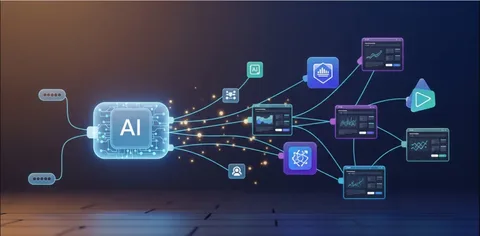
AI Automation is the practice of using artificial intelligence, such as machine learning, natural language processing (NLP), and computer vision, to automate complex tasks that traditionally required human intelligence and manual effort.
AI automation can learn from data, recognize patterns, and make decisions to improve its performance over time.
How AI Automation Differs from Traditional RPA?
The AI automation and Robotic Process Automation are somehow treated synonymously. However, there is a difference between the two that needs to be addressed before moving forward.
Robotic Process Automation (RPA)
RPA is a rule-based technology. It mimics human actions by following a strict, pre-defined script. It is designed for repetitive, high-volume tasks that never change.
AI Automation
AI Automation (often called Intelligent Automation) is judgment-based. It uses machine learning and natural language processing to handle complexity, recognize patterns, and make decisions.
Real Case Scenario
Imagine you are running a busy cafe. Here is how both technologies would handle different parts of the business:
RPA: The Automated Espresso Machine
The machine has a button for a Large Latte. Every time you press it, the machine performs the same steps: it grinds 18g of beans, pumps 2oz of water at a specific pressure, and steams milk for 20 seconds.
Why it’s RPA: It follows a strict recipe. If you run out of milk, the machine doesn’t “decide” to use oat milk instead; it simply stops or keeps pumping air. It is perfect for consistency, but it has zero “common sense.”
AI: The Experienced Barista
The barista sees a customer walk in, looking tired and shivering. Without being told, the barista thinks, It’s cold outside, and the customer looks exhausted. Based on the condition of the customer, the Barista would suggest an extra-shot ginger-spiced latte.
Why it’s AI: The barista is observing unstructured information (the weather, the customer’s body language) and making a judgment based on past experience to provide a specific result.
In simple words:
- RPA is a digital clerk that handles the paperwork
- AI is a digital clerk that analyzes the big picture and solves the problem.
AI Automation for Businesses
AI automation in business is being leveraged by owners to minimize errors, boost efficiency, and improve business operations and processes. Unlike traditional automation, AI incorporates Machine Learning (ML), Natural Language Processing (NLP), and computer vision to break down the unstructured data.
In this section, we are going to reveal some of the real-life AI automation business examples to help you understand how it can be your next big partner.
AI Automation in Customer Support
AI Automation in customer support is widely popular to speed up the response time, reduce errors, handle inquiries by customers, and enhance the overall quality of the service. Most commonly, customer support is automated by integrating different tools like chatbots or virtual assistants.
A lot of service-based companies have deployed AI automation to enhance the experience of their customers. Without involving humans, the chances of errors are zero, and provide more room for human resources to utilize their energy and skills in high-value tasks.
AI Automation in Marketing
AI Automation in marketing has helped business owners to make more informed decisions and personalize content that syncs with the customers. The AI automation in digital marketing works by continuously learning from customers’ behavior and optimizing the campaign accordingly.
One of the benefits of AI systems is that they can categorize audiences based on their interests and preferences.
Moreover, these AI systems can also forecast customer actions, customize messages, and adjust campaigns and content automatically.
Thus, AI provides marketers a pathway to handle their campaigns intelligently by forecasting customer actions based on past behaviors.
AI Automation in Healthcare
AI automation in healthcare gives healthcare providers a tool to help them deal with complex paperwork involving patients’ data, diagnosis, and treatment. From suggesting medicines to providing a better cure, these AI tools can help in facilitating doctors and admin staff to reduce errors, improve efficiency, and speed up the recovery process. Here are some of the scenarios of AI automation in healthcare.
Administrative Automation: The AI-powered solution listens to doctor-patient conversations and automatically generates clinical notes, reducing paperwork time by up to 60%. It also handles complex billing, insurance authorizations, and scheduling.
Diagnostic Automation: AI algorithms scan X-rays, MRIs, and CT scans in seconds to diagnose medical conditions like tumors or blood clots for radiologists to review, often catching details invisible to the human eye.
Operational Automation: Hospitals use predictive AI to manage effective patient flow when beds open up, or to identify which patients in the ER need to be treated first based on their condition.
AI Automation in Banking and Finance
AI Automation in banking and finance leverages machine learning to streamline operations, improve decision-making, and strengthen security. The automation allows financial institutions to speed up their tasks and adopt real-time and adaptive measures.
The AI automation is helpful in fraud detection, such as transaction patterns and custom behavior, to track any suspicious activity in real time.
The banks can use AI chatbots and virtual assistants to answer queries and personalize recommendations based on customer answers. Even if the bank is closed, the AI chatbots and virtual assistants can facilitate customers 24/7
AI also scrutinizes the loan applications in volume by analyzing the datasets and creditworthiness. It assists banks in determining whether the person is worth giving a loan who can repay in the future or not.
Benefits and Importance of AI Automation for Business
AI automation for businesses holds great importance in the modern era. Adopting the latest technology and leveraging it in the business provides many benefits. Here’s how businesses can benefit from AI automation.
Higher Productivity
AI is more productive than humans and can complete tasks within minutes instead of hours. For instance, a simple data entry work for a human might take hours to complete. But the same task for AI can be carried out within minutes, without risking any errors. Leveraging AI automation in business allows employees to focus more on strategic priorities and less on the clerical side.
Saving Cost
A lot of business owners have realized how AI automation can save their time, energy, and effort. Automating repetitive tasks reduces workload and operational costs. A study found that organizations that leveraged AI reported 20-25% more productivity, reaching to as much as 40% over time.
Enhanced Efficiency
AI automation helps in streamlining workflows and helps teams to achieve optimal productivity with less effort. The enhanced efficiency is directly reflected on business’s overall workflow, better revenue, and more profits.
Free of Errors
Humans are vulnerable to errors and mistakes, especially when it comes to repetitive tasks that may look easy, but the chances of errors are high. However, the AI automation for business helps in minimizing human mistakes and empowers compliance, which ultimately results in building customer trust.
Informed Decision-Making
AI can analyze data in a large number of both structured and unstructured. Evaluating the data and using the information at the right time and place helps in taking decisions that facilitates in business’s growth.
Better ROI
In most businesses, a huge portion of labor costs goes to moving data from one place to another. Usually, if a business grows by 50%, they need to hire 50% more people. With AI automation, the software handles the extra volume, allowing the current team to stay the same size while the company grows, resulting in better ROI.
Challenges of AI Automation
AI automation is filled with a lot of opportunities and benefits. But it also comes with real challenges that businesses need to manage carefully. Here are the most important ones you need to know as a business owner.
High Implementation Costs: Developing, integrating, and maintaining AI systems can be expensive, especially for small and mid‑sized companies.
Data quality & availability issues: AI needs large amounts of clean, reliable data. Many businesses struggle with fragmented, outdated, or incomplete data.
Skill gaps & talent shortages: AI requires expertise in data science, automation engineering, and machine learning. Many companies lack the internal skills to manage these systems effectively.
Integration with existing systems: Legacy software, outdated infrastructure, and siloed tools can make AI adoption slow and complex.
Security & privacy risks: AI systems handle sensitive data, making them targets for cyberattacks. Businesses must ensure strong security and compliance.
Ongoing maintenance & monitoring: AI is not “set and forget.” It requires continuous updates, retraining, and oversight to stay accurate and effective.
Ethical & regulatory challenges: Businesses must navigate evolving laws around AI transparency, data use, and accountability.
Summing Up
AI automation is no longer just a luxury but a new standard for modern business. Some complications and challenges need to be addressed, such as cost, effort, and time. But the rewards are too big and too good to ignore.
By automating the business processes, your team works faster and more accurately, leading to better outcomes, improved ROI, and subpar efficiency.
Let Phoenix Coderex Automate the Path Forward
AI automation and integration are likely to give you the edge over competitors. Be it a small business, an emerging brand, or a startup, Phoenix Coderex has got your back with the most advanced AI consulting, integration, and automation.
Get in contact with us and let us know your requirements.

Automate repetitive tasks, streamline workflows, and boost efficiency using smart AI solutions designed to save time, reduce costs, and improve business productivity.